Sports Entertainment
Chairshot Top 5: Most Painful Wrestling Moves to Take
Which wrestling moves hurt the most? Wrestlers reveal the painful reality behind five devastating moves, from GUNTHER’s chop to The Great Khali’s chokeslam.

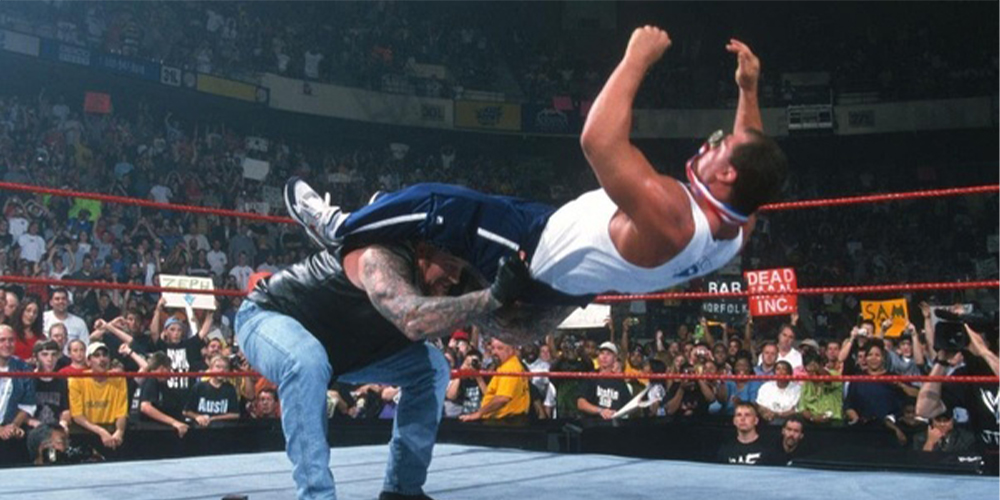
Which wrestling moves hurt the most? Wrestlers reveal the painful reality behind five devastating moves, from GUNTHER’s chop to The Great Khali’s chokeslam.
Professional wrestling requires performers to make dangerous moves look devastating without actually destroying one another. Some moves, however, simply hurt regardless of how safely they are delivered.
Calling professional wrestling predetermined has never meant calling it painless. Wrestlers learn how to protect themselves, distribute the force of a landing and cooperate with the person delivering a move. None of those skills can eliminate gravity, ring boards or the unpleasant reality of another human being landing on top of you. It still hurts.
The most frightening-looking move is not always the most painful, either. A complicated maneuver might give the recipient several ways to control the landing, while an ordinary slam can offer little protection beyond accepting the impact. Some moves hurt because of the height. Others hurt because of the speed, weight or awkward position involved. A few just involve another person hitting you as hard as possible.
This ranking considers the mechanics of each move, the performers associated with it and accounts from wrestlers who have actually experienced the pain. These are the five most painful wrestling moves to take.
5. GUNTHER’s Knife-Edge Chop
A knife-edge chop is one of wrestling’s simplest moves. The wrestler opens his hand and strikes his opponent across the chest. No rotation, elaborate setup or crash landing is required. When GUNTHER delivers one, the lack of complexity is precisely what makes it terrifying.
There is nowhere for the recipient to hide. The strike lands directly on exposed skin, producing the gunshot-like sound that has become a signature part of GUNTHER’s matches. His opponents frequently leave the ring with bruises, welts and a chest that looks as though it lost an argument with a belt sander.
Pat McAfee provided one of the clearest demonstrations after facing GUNTHER at WWE Backlash in 2025. McAfee shared an image of his visibly battered chest afterward and said it was burning. The picture reportedly attracted more than 800,000 views within six hours because the damage required no wrestling expertise to understand. One look told the entire story.
A chop is unlikely to produce the catastrophic landing associated with some of the moves higher on this list. It offers a different variety of suffering: immediate, concentrated and impossible to disguise. GUNTHER is not trying to create the illusion that his hand made contact. He is trying to make the contact impossible to ignore.
4. Finn Bálor’s Coup de Grace
The Coup de Grace asks its recipient to remain flat on the mat while Finn Bálor jumps from the top rope and lands with both feet on their torso. Wrestling technique allows Bálor to bend his knees, shift his weight and roll away rather than driving every pound of force directly through his opponent. That makes the move performable. It does not make it pleasant.
The recipient still has to absorb the feet of a fully grown man descending from the top turnbuckle. There is no broad back bump to spread the collision across the body. The force is concentrated around the chest and abdomen, two areas people generally spend their lives protecting from falling objects.
Bálor’s control is what allows the Coup de Grace to remain part of his regular repertoire. WWE has occasionally amplified its brutality by adding a weapon, including a version in which Bálor delivered the move with a steel chair wrapped around Edge’s leg. Those variations reveal why the ordinary version already looks so convincing: the underlying mechanism requires a level of trust that most people would not extend to their closest friends.
Some moves hurt because something went wrong. The Coup de Grace appears to hurt when everything goes exactly according to plan.
3. The Undertaker’s Last Ride
A standard powerbomb is already among wrestling’s least inviting experiences. The recipient is lifted onto another wrestler’s shoulders and driven back-first into the mat. The Undertaker decided that the logical improvement was to lift the person even higher before dropping them.
The Last Ride begins like a powerbomb, but Undertaker extends his arms and elevates his opponent above the normal position. That extra height increases the distance of the fall and gives the recipient more time to contemplate the landing awaiting them.
JBL called the Last Ride the most painful finisher he experienced during his WWE career. He was careful to emphasize that Undertaker was one of wrestling’s safest performers and did not hurt him through carelessness. The pain came from the move itself. JBL recalled being unprepared for the height the first time he took it and said the resulting impact knocked the wind out of him.
That distinction matters. A move does not need to be unsafe to be punishing. Undertaker could deliver the Last Ride correctly, protect his opponent and still make that opponent wonder how the ring had suddenly become concrete. Safety prevents an injury; it does not promise comfort.
2. Hardcore Holly’s Alabama Slam
Most conventional slams give wrestlers some ability to watch the mat approach, adjust their bodies or use their arms to help control the landing. The Alabama Slam removes much of that comfort.
Hardcore Holly would collect both of an opponent’s legs, lift the wrestler upside down behind him and swing the person forward with considerable speed. The recipient could do little except trust Holly, brace for impact and hope the back of their head did not bounce off the canvas.
The movement created a whiplash effect that made the Alabama Slam appear more violent than many finishers involving greater height. Holly’s delivery added another complication. His entire presentation was built around being an unusually physical wrestler, and he did not perform the move as though gently placing luggage on the floor.
The Alabama Slam also demonstrates why speed can be as intimidating as height. The recipient does not simply fall onto the mat. They are accelerated toward it while their legs remain controlled, limiting the ability to make adjustments. It was visually impressive, mechanically straightforward and consistently looked miserable to receive.
Nobody needed Hardcore Holly to perform a Canadian Destroyer. Swinging another human being into the canvas like he was trying to remove dust from a rug worked perfectly well.
Honorable Mention: Brock Lesnar’s F-5
Brock Lesnar’s F-5 narrowly misses the main ranking because the quality of the landing can vary. That unpredictability is also what makes the move so dangerous to receive.
Lesnar lifts his opponent across his shoulders, throws the wrestler outward and forces them to rotate through the air before landing. Unlike a traditional back bump, the recipient must manage the spin and attempt to land flat while moving forward without full control over the release.
Matt Hardy has compared the F-5 directly with Undertaker’s Last Ride and identified Lesnar’s move as the more treacherous of the two. Hardy explained that the rotation makes the landing more difficult to control. He particularly remembered receiving an F-5 on the entrance stage during Raw in 2002, where there was none of the padding provided by a wrestling ring. Even though Hardy landed as flat as possible, he described the impact as brutal.
The F-5 can look smooth when everything aligns. When Lesnar adds his strength and explosiveness to a hard surface or an awkward release, it can also resemble being ejected from a moving vehicle.
1. The Great Khali’s Chokeslam
A chokeslam is only as forgiving as the person delivering it. That becomes a problem when the person holding you in the air is The Great Khali.
At more than seven feet tall, Khali did not need to manufacture the illusion of elevation. His opponent began the move looking up at a giant, was lifted by the throat and then traveled an extraordinary distance before hitting the mat. Even wrestlers accustomed to Kane, Big Show and The Undertaker encountered a different physical equation with Khali.
The Miz identified Khali’s chokeslam as the most painful finisher he had ever taken. In discussing chokeslams and powerbombs generally, Miz explained that he tried to jump as high as possible when receiving one, which only increased the distance he traveled before returning to the mat. With Khali, that meant an enormous fall and a landing powerful enough to leave a lasting impression on a wrestler who has absorbed nearly every major WWE finisher of his generation.
Khali’s size also made the move look less like a collaborative wrestling technique and more like a giant disposing of an inconvenience. There was no elaborate rotation to distract the audience and no sequence of reversals preceding the impact. Khali lifted someone frighteningly high and dropped them.
The best wrestling moves create the appearance of terrible pain while protecting the people involved. The Great Khali’s chokeslam accomplished the first part so convincingly because, according to The Miz, it never entirely solved the second.
Professional wrestlers can control how they fall, but they cannot negotiate with gravity. GUNTHER’s chop concentrates pain into one violent strike, the Coup de Grace puts two feet directly over the torso, and the Alabama Slam accelerates its recipient toward the canvas with limited control. The Last Ride and Khali’s chokeslam use the oldest special effect in wrestling: lifting someone much higher than they want to be before letting them fall.
The performers delivering these moves were generally trusted professionals. That is what allowed opponents to take them repeatedly without every execution ending in injury. Safe, however, is a relative term inside a wrestling ring. Sometimes it merely means the move hurt exactly as much as it was supposed to hurt.
This article includes information from WWE.com, SlamWrestling.net, Fightful.com, TalkSport.com and The Extreme Life of Matt Hardy.
Chairshot Radio Network
Launched in 2017, the Chairshot Radio Network presents you with the best in sports, entertainment, and sports entertainment. Wrestling and wrestling crossover podcasts + the most interesting content + the most engaging hosts = the most entertaining podcasts you’ll find!
MONDAY - Bandwagon Nerds
TUESDAY - 4 Corners Podcast
WEDNESDAY - The Grown Ass Man Podcast
THURSDAY - The Benchwarmers Trivia Podcast
FRIDAY - DWI Podcast (Drunk Wrestling Intellect)
SATURDAY - The Mindless Wrestling Podcast
SUNDAY - 30 Mindless Minutes
CHAIRSHOT RADIO NETWORK PODCAST SPECIALS
Attitude Of Aggression Podcast: The Big Five Project (chronologically exploring WWE's PPV/PLE history) Unidentified History (Ufology) & Game Gone Wrong (Game of Thrones Universe)
Chairshot Radio Network Your home for the hardest hitting podcasts... Sports, Entertainment and Sports Entertainment!
Powered by RedCircle
Let us know what you think on social media @ChairshotMedia and always remember to use the hashtag #UseYourHead!

Chairshot NFL News Report (10/9/2026): Buccaneers Stun Cowboys, Payton Takes Over & Pittman Sidelined
Tampa Bay stuns Dallas on Thursday Night Football, Sean Payton takes back Denver's offense and Michael Pittman Jr. faces a...


Chairshot NFL: Week 5 Preview, Greg’s New Power Rankings
Andrew Balaz is joined by Greg DeMarco (filling in for PC!) for Week 5 picks, NFL power rankings, weekly standouts,...

Chairshot NFL News Report (10/8/2026): Eagles Trade Jurgens, Ryans Takes Control & Mayfield Out
Philadelphia trades Cam Jurgens to Baltimore, DeMeco Ryans takes over Houston's defense and Baker Mayfield misses Thursday Night Football.

Greg DeMarco’s NFL Power Rankings – Week 4
The 49ers lead The Greg DeMarco's first 2026 NFL Power Rankings, followed by the Chiefs, Jaguars, Vikings and Bears. See...

Chairshot NFL News Report (10/7/2026): Lane Johnson Retires, Lamar Unlikely & Daniels Nears Return
Lane Johnson retires after 14 seasons, Lamar Jackson is unlikely for Week 5 and Jayden Daniels moves closer to returning...

Bandwagon Nerds News Report (10/9/2026): Cyberpunk Goes Hollywood, Xbox Builds XP & Marvel Reveals Zodiac
Cyberpunk 2077 gets a Paramount movie, Xbox launches its XP entertainment division and Marvel reveals Zodiac at New York Comic...

Grown Ass Man Podcast #008: Every Show Has An Alias Season 4
Greg and Patrick tackle college football chaos, Disney FOMO, sports cameos, WWE and wrestling fandom, TV nostalgia, and grown-ass adult...

Bandwagon Nerds News Report (10/6/2026): ARC Raiders Goes Hollywood, Skydance Locks in Bloys & Tulsa King Hits Five
ARC Raiders and The Finals head to Hollywood, Casey Bloys locks in at Skydance and Tulsa King scores an early...
Bandwagon Nerds #361: A Very Important Pancho!
The Nerds discuss episode 7 of Lanterns, look at the latest trailers, discuss a Game of Thrones movie coming in...

Bandwagon Nerds News Report (10/5/2026): Endgame Retakes No. 1, Lanterns Sets Up DCU & Gears Returns
Endgame retakes the all-time box office crown, Lanterns sets up John Stewart’s DCU future and Gears of War: E-Day arrives...

Andrew’s JCW Lunacy Results & Ratings: Ep# 102
Bigfoot...possibly in action? Big Al needs some friends and Caleb's big ego needs to be put in check. JCW LUNACY...

Chairshot Top 5: Most Ridiculous Things Hidden Under a Wrestling Ring
From Dean Ambrose’s chainsaw to a giant mousetrap and an entire courtroom, these are the most ridiculous things found under...

Today In Pro Wrestling History: October 9th
Relive iconic wrestling moments: from Rikishi’s shocking 2000 WWF confession to Sasaki’s 2004 NJPW title win, Angle’s TNA debut, and...

DWI Podcast #537: Tunney in the Bank
Don't drink and drive, drink and podcast! Join DP and PC weekly for their thoughts on RAW, SmackDown and every...

Chairshot Wrestling News Report (10/9/2026): Shayna Baszler Arrives, Nemeths Retain & Avery Styles Takes Flight
Shayna Baszler heads to TNA Bound For Glory, the Nemeths retain against The Hardys, and Avery Styles delivers a familiar...

Andrew’s TNA iMPACT! Results & Ratings: 10.8.2026
TNA Bound for Glory Go Home show! Tag Titles on the line between the Nemeths and Hardys and the KO...


Axe Bomber Podcast #004: TNA Bound For Glory 2026 Preview & Predictions, Wren Sinclair, & More!
Greg DeMarco and Andrew Balaz preview TNA Bound for Glory, spotlight Wren Sinclair in NXT and revisit PAC vs. KZY...

Today In Pro Wrestling History: October 8th
Relive wrestling history! From WWF Raw 2001 & WWE Hell in a Cell 2017 to classic NJPW & NWA title...

Chairshot Wrestling News Report (10/8/2026): Cody Re-Signs, MJF Targets NJPW & Jim Ross Recovers
Cody Rhodes signs a new WWE deal, MJF challenges NJPW's Ryohei Oiwa, Jim Ross receives positive news and TNA prepares...

Today In Pro Wrestling History: October 7th
From Sherri & Robin’s 1988 classic to Brodie & Cody’s bloody war, ring action has shaped history. Revisit No Mercy...