Sports Entertainment
Chairshot Top 5: Greatest Wrestling Entrance Themes of All Time
From The Undertaker’s funeral bell to Stone Cold’s shattered glass, these are the five greatest wrestling entrance themes of all time.

From The Undertaker’s funeral bell to Stone Cold’s shattered glass, these are the five greatest wrestling entrance themes of all time.
The greatest wrestling entrance themes do more than accompany someone to the ring. They create anticipation before the wrestler appears, define the character within seconds and become so permanently connected to one performer that hearing the opening note can make an arena erupt.
Professional wrestling existed for generations without entrance music becoming an essential part of the presentation. That began changing dramatically in the late 1970s and early 1980s, when performers such as Michael Hayes and The Fabulous Freebirds helped demonstrate how much personality could be communicated before anyone ever reached the ring.
Once wrestling promoters understood that idea, the entrance theme became almost as important as the costume, finishing move or catchphrase. A perfectly chosen song could turn the walk to the ring into an event of its own, while the opening seconds eventually became enough to trigger an audience reaction before the wrestler was even visible.
That opening is particularly important. Wrestling entrance music does not have several minutes to establish itself like a conventional song. The greatest themes announce exactly who is coming almost instantly, whether through breaking glass, a funeral bell, a guitar riff or an orchestral blast that sounds like royalty has entered the building.
This ranking considers more than whether the song itself is enjoyable. The strongest wrestling entrance themes fit the wrestler, create an immediate crowd response, improve the overall presentation and remain inseparable from the performer years after the original run has ended.
These are the Top 5 greatest wrestling entrance themes of all time.
#5 — Hulk Hogan: “Real American”
Few wrestling songs have ever communicated their message as directly as “Real American.” The opening guitar immediately announces triumph, the lyrics make absolutely no attempt at subtlety and the entire song feels specifically designed for someone wearing red and yellow while pointing dramatically toward thousands of cheering people.
Rick Derringer performed the track, which appeared on 1985’s The Wrestling Album before becoming permanently associated with Hulk Hogan. WWE was rapidly expanding into a national entertainment company at the time, and Hogan stood at the center of that transformation as wrestling increasingly embraced music videos, celebrity involvement and larger-than-life television presentation.
The song amplified virtually everything Hogan was selling. He was presented as patriotic, optimistic and almost cartoonishly heroic, and “Real American” sounded less like entrance music than the theme song to the entire Hulkamania movement.
That association became strong enough that the song could create enormous reactions decades after Hogan’s prime. WWE repeatedly used the first recognizable notes to signal surprise Hogan appearances, including his memorable WrestleMania 21 return, because the audience did not need to see him before understanding who was coming.
There are technically better songs on this list, and several themes fit their wrestlers with more nuance. “Real American” earns its position because it helped establish the template for what mainstream wrestling entrance music could accomplish when the song, character and moment all became part of the same package.
#4 — Ric Flair: “Also sprach Zarathustra”
Ric Flair did not need someone to write him an original entrance song. He found something considerably grander.
Richard Strauss’ “Also sprach Zarathustra” existed long before professional wrestling and became famous outside the industry through Stanley Kubrick’s 2001: A Space Odyssey. Flair adopted the dramatic opening fanfare during his career, and the composition eventually became so strongly associated with “The Nature Boy” that wrestling audiences heard those orchestral notes very differently from everyone else.
The music fits Flair because it sounds important before anything actually happens. The escalating brass creates the feeling that someone significant is approaching, which was exactly the message needed for a wrestler who routinely described himself as the best in the world while arriving in expensive robes and carrying championship gold.
Flair used the theme for decades, and WWE itself has noted that the composition had accompanied him since the 1970s. Even when his first WWE run included a modified version of the concept, the familiar Strauss fanfare remained the sound most closely associated with his career.
The remarkable part is how little the music needs Flair-specific production. There is no recorded “Woo!” required at the beginning and no lyric explaining who he is, because the dramatic opening eventually became enough.
That is the mark of an extraordinary wrestling theme. Flair borrowed a piece of classical music that already represented grandeur and somehow spent enough years walking to the ring behind it that professional wrestling claimed part of its identity.
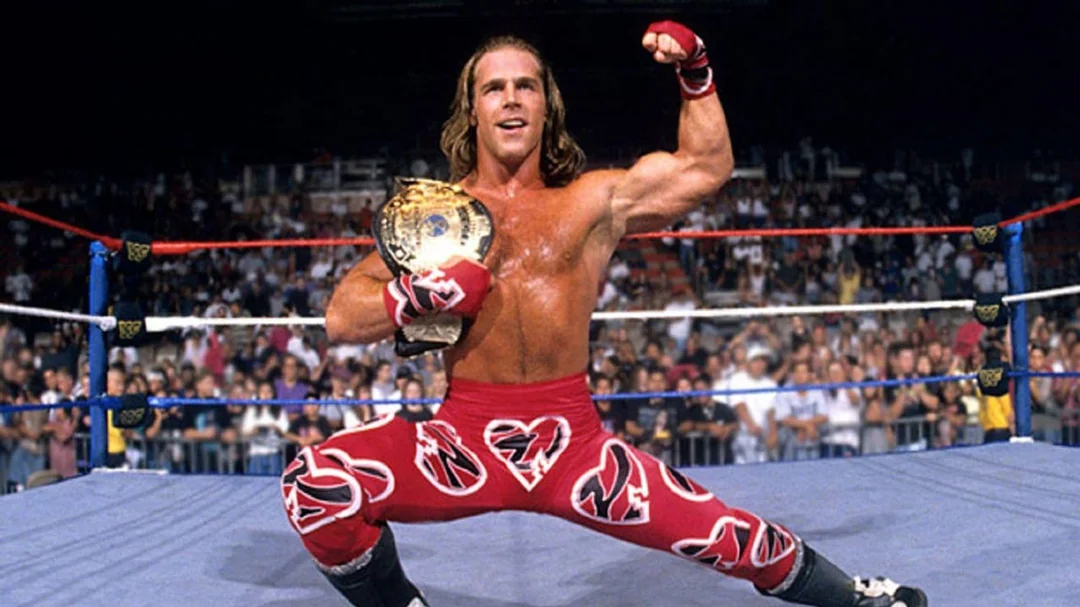
#3 — Shawn Michaels: “Sexy Boy”
On paper, Shawn Michaels singing his own entrance theme should have been dangerously close to parody. Instead, “Sexy Boy” became one of the most perfectly self-absorbed pieces of wrestling music ever recorded.
The song was written by Jimmy Hart and Jim Johnston, with Sensational Sherri originally providing the vocals before Michaels eventually recorded the version that became permanently attached to him. WWE has repeatedly highlighted how completely the track captured the arrogance and charisma of the Heartbreak Kid character.
That is exactly why it works.
“Sexy Boy” does not attempt to make Michaels sound dangerous in the traditional wrestling sense. The song announces that the person arriving is completely convinced of his own attractiveness and importance, which perfectly matched the cocky singles character Michaels developed after leaving The Rockers.
The music then became something more impressive by surviving the character’s evolution. Michaels eventually transformed from an arrogant young heel into one of WWE’s most respected veterans, yet the same boastful song remained attached to him without ever feeling like something he had outgrown.
Part of that comes from the entrance itself. Michaels kneeling in the aisle, flexing while pyro exploded behind him and posing to the rhythm of the music turned “Sexy Boy” into choreography rather than background sound. The song and physical entrance became one piece of presentation.
There is also an authenticity to Michaels providing the vocals that would have been difficult to manufacture for someone else. The song is ridiculous because the character is ridiculous, but Michaels performed everything with enough commitment that the ridiculousness became confidence.
A wrestling theme should tell the audience who someone is. “Sexy Boy” essentially gives a complete Shawn Michaels character summary before the first verse ends.
#2 — The Undertaker: “Graveyard Symphony”
The greatest wrestling entrance music does not necessarily need lyrics, a recognizable rock band or even a conventional song structure. Sometimes one sound is enough.
The toll of The Undertaker’s funeral bell became one of the most powerful audio cues professional wrestling ever created. When the arena went dark and that first gong echoed through the building, the audience knew exactly what was about to happen, and the anticipation became part of the performance before The Undertaker appeared through the smoke.
Jim Johnston developed the music after being given the basic concept of an enormous wrestler presented as a dead man. Johnston later explained that an early piano approach felt too delicate, so he imagined the music being played in a massive cathedral and expanded it with organ, choir and bells.
That decision created something closer to funeral music than a traditional wrestling theme. The slow pace forced the entrance to operate on The Undertaker’s terms, and opponents waiting in the ring were effectively required to stand there while the entire building watched him approach.
The theme also proved remarkably durable. Different Undertaker eras introduced variations, darker arrangements and completely different songs during his American Bad Ass period, but the classic Deadman presentation always returned to the same essential musical identity. WWE eventually released a compilation containing numerous versions of the theme spanning from his 1990 debut through later variations.
More importantly, the music changed the atmosphere of arenas. Most wrestling themes encourage excitement, but The Undertaker’s entrance created silence, anticipation and spectacle at the same time.
WWE has repeatedly ranked The Undertaker among the greatest entrances in company history, and the music is the foundation beneath almost every version of that presentation.
The gong is not merely the beginning of a song. It is one of professional wrestling’s most recognizable sounds.
Honorable Mention — Triple H: “The Game”
Triple H had enough excellent entrance music to make choosing one theme surprisingly difficult. “My Time” perfectly suited his rise around 1999 and 2000, “King of Kings” fit his later presentation and “Line in the Sand” gave Evolution one of wrestling’s strongest faction themes.
“The Game” became the definitive one.
Jim Johnston wrote the song, and Motörhead performed it with Lemmy Kilmister delivering the opening declaration that immediately announces Triple H’s arrival. Johnston worked repeatedly with Triple H and Motörhead over the years, while the band also performed his music live at WrestleMania.
The theme works because it feels heavy without becoming frantic. Triple H’s entrance was methodical, and the music gave him enough time to stand beneath the lights, walk deliberately toward the ring and reach the apron precisely as the presentation hit its biggest moment.
It also sounded legitimate in a way licensed or commissioned wrestling music sometimes struggles to achieve. Motörhead was already an established metal band, and Lemmy’s voice gave “The Game” an authority that made the song sound like something Triple H had chosen rather than something assigned to him.
He narrowly misses the main ranking because the five selections above became even more universal wrestling audio cues. As a complete combination of wrestler, song and entrance choreography, however, “The Game” belongs in any serious conversation about wrestling’s greatest themes.
#1 — “Stone Cold” Steve Austin: “I Won’t Do What You Tell Me”
The greatest wrestling entrance theme of all time begins by destroying something.
Glass shatters, the arena erupts and Steve Austin is usually already halfway through the curtain before the crowd has finished reacting.
Jim Johnston’s instrumental theme, commonly identified as “I Won’t Do What You Tell Me,” became the perfect soundtrack for the wrestler who defined WWE’s Attitude Era. The aggressive guitar riff sounded confrontational without becoming overly complicated, but the real genius was the opening effect.
The glass did almost all the work.
Wrestling entrance themes frequently need several seconds before audiences identify them. Austin’s theme required a fraction of one second, and WWE could use that sound in virtually any situation to create an immediate reaction.
The effectiveness became particularly obvious during surprise appearances. Whether Austin was interrupting Vince McMahon, arriving for a match or returning after an absence, the shattering glass functioned almost like an emergency alarm announcing that whatever had been happening was about to change.
WWE itself has repeatedly described that opening as the signal that Austin was arriving and trouble was about to follow. The company also commissioned alternate versions over the years, including Disturbed’s “Glass Shatters,” but every variation retained the essential identity established by Johnston’s original.
The theme also perfectly matched Austin’s movement. He did not pose at the top of the ramp or wait for the music to establish him. Austin marched quickly toward the ring, climbed onto the turnbuckles and treated the entrance like he had somewhere important to be.
That urgency separated him from almost everyone else on this list. The Undertaker made the audience wait. Ric Flair made the entrance feel ceremonial. Shawn Michaels performed along with his music, and Hogan turned his into a celebration.
Austin’s theme sounded like an interruption.
That is why it belongs at No. 1. No entrance theme in wrestling history has produced more immediate understanding from a single sound, and very few have matched the song, character and audience reaction as perfectly.
The glass breaks, and everyone knows what happens next.
The best wrestling entrance themes eventually stop functioning like ordinary songs. They become audio logos capable of summoning an entire character before the wrestler ever appears on screen.
“Real American” represents the optimism and spectacle of Hulkamania, while “Also sprach Zarathustra” turned Ric Flair’s walk to the ring into an announcement of importance. Shawn Michaels used “Sexy Boy” to make arrogance entertaining, and Triple H transformed Motörhead into part of his identity.
The Undertaker and Steve Austin demonstrate the concept in its purest form because neither requires more than an opening sound. A funeral bell creates anticipation, while breaking glass creates immediate chaos.
That is the standard every wrestling entrance theme is ultimately chasing. The song does not merely need to sound good; it needs to make an audience feel something before the wrestler takes a single step toward the ring.
Austin’s theme accomplished that faster than any of them.
Meta Title:
Meta Description:
Research included archival and historical material from WWE.com covering WWE entrance music history, Jim Johnston’s theme development, “Real American,” Ric Flair’s use of “Also sprach Zarathustra,” Shawn Michaels’ “Sexy Boy,” The Undertaker’s theme variations and Motörhead’s work with Triple H.
Chairshot Radio Network
Launched in 2017, the Chairshot Radio Network presents you with the best in sports, entertainment, and sports entertainment. Wrestling and wrestling crossover podcasts + the most interesting content + the most engaging hosts = the most entertaining podcasts you’ll find!
MONDAY - Bandwagon Nerds
TUESDAY - 4 Corners Podcast
WEDNESDAY - The Grown Ass Man Podcast
THURSDAY - The Benchwarmers Trivia Podcast
FRIDAY - DWI Podcast (Drunk Wrestling Intellect)
SATURDAY - The Mindless Wrestling Podcast
SUNDAY - 30 Mindless Minutes
CHAIRSHOT RADIO NETWORK PODCAST SPECIALS
Attitude Of Aggression Podcast: The Big Five Project (chronologically exploring WWE's PPV/PLE history) Unidentified History (Ufology) & Game Gone Wrong (Game of Thrones Universe)
Chairshot Radio Network Your home for the hardest hitting podcasts... Sports, Entertainment and Sports Entertainment!
Powered by RedCircle
Let us know what you think on social media @ChairshotMedia and always remember to use the hashtag #UseYourHead!


Chairshot NFL News Report (11/6/2026): Jaguars Crush Ravens, Lamar Jackson Hits IR & Vikings Lose Murray
Jacksonville dominates Baltimore on Thursday Night Football, Lamar Jackson lands on injured reserve, and Minnesota turns to Carson Wentz.


Greg DeMarco’s Top 5 NFL Week 9 Matchups
Greg DeMarco ranks the five NFL Week 9 matchups that matter most, led by Bills-Vikings, Packers-Patriots and Jaguars-Ravens.


Greg DeMarco’s NFL Power Rankings: 49ers Retake No. 1 After Week 8
The 49ers reclaim No. 1 in Greg DeMarco's NFL Power Rankings after Week 8, while the Bears, Steelers and Broncos...


Chairshot NFL News Report (11/4/2026): Ravens Turn to Joe Fagnano, Colts Extend Adebawore & Commanders Lose Three More
Baltimore names Joe Fagnano its starter, Indianapolis extends Adetomiwa Adebawore, and Washington suffers three more injured reserve losses.


4 Corners Podcast: Milwaukee’s Best!
The 4 Corners Podcast is back as PC Tunney celebrates the Brewers winning the World Series, while college football continues...


30 Mindless Minutes: Couples Therapy – 2027 Concerts
Take your mind off of things, for 30 minutes.

Bandwagon Nerds News Report (11/7/2026): EA Revives the Classics, Dragon Age Talent Joins The Expanse & Good Boy Director Returns
EA restores Road Rash and Wing Commander, David Gaider joins The Expanse RPG, and Good Boy director Ben Leonberg takes...

Bandwagon Nerds News Report (11/6/2026): John Wick Returns, Monsterverse Expands & Godzilla Arrives
Keanu Reeves returns for an animated John Wick prequel, Apple’s Monsterverse adds major stars, and Godzilla Minus Zero hits theaters.


Bandwagon Nerds News Report (11/5/2026): Paramount Eyes HBO, MASHLE Goes Live & Starlog Returns
Paramount considers moving dramas to HBO, MASHLE gets a live-action movie and legendary sci-fi magazine Starlog returns after 17 years.


Chairshot NFL News Report (11/5/2026): Ravens Pursue Brissett, Aiyuk Seeks Return & Parsons Practices
Baltimore moves to acquire Jacoby Brissett, Brandon Aiyuk seeks reinstatement, and Micah Parsons returns to practice as NFL injuries mount.

Today In Pro Wrestling History: November 8th
From Gagne vs. Bockwinkel in '75 to Eddie's final match in '05, NJPW '14, Stardom '15, and NOAH '25—relive the...

Mitchell’s AEW Collision Results & Report! (11/7/26)
Sail away, man~!

Andrew’s MLW Fusion Results & Ratings: S8 E26
We get an Opera Cup Quarter-Finals Match and an MLW World Heavyweight Title Match! Killer Kross puts the belt on...

Mitchell’s WWE Crown Jewel Results & Report! (11/7/26)
Who is truly the best?

Today In Pro Wrestling History: November 7th
From the historic 1985 Wrestling Classic and 2004 Victory Road to AJ Styles' 2017 title win, XPW Rebirth, and Raw...


Mindless Wrestling Podcast: Main Event Game!
Tune in every week as DJ, Rob and Jason give their thoughts on the world of pro wrestling and beyond!

Chairshot Wrestling News Report (11/7/2026): Owens Knocks Out Punk, Charlotte Returns & NJPW Closes U.S. Subsidiary
Kevin Owens defeats CM Punk, Charlotte Flair returns on SmackDown, NJPW closes its American subsidiary, and Crown Jewel approaches.

Chairshot NFL News Report (11/7/2026): Ravens Complete Brissett Trade, Shedeur Sanders Starts & Aiyuk Meets 49ers
Baltimore finalizes its Jacoby Brissett trade, Cleveland names Shedeur Sanders its starter, and Brandon Aiyuk meets with San Francisco.


Mitchell’s WWE SmackDown Results & Report! (11/6/26)
NO HOLDS BARRED!

Andrew’s JCW Lunacy Results & Ratings: Ep #106
Mr JCW makes his in-ring debut, Father Bronson officially rebrands to Red Love while he puts his American title against...